Regionalization

RCAP has facilitated hundreds of regionalization projects across the country, helping to spur collaboration and drive economies of scale for small rural communities. RCAP often assumes the role of a neutral third-party facilitator, guiding communities through the often complex steps of the regionalization process and providing them with resources and services so that they can make informed decisions about their future.
Why Regionalization?
We believe regionalization helps to:
- Solve common challenges like access to affordable supplies, sharing the cost of certified operators, or making rates more reasonable.
- Build resiliency in the face of both predicted and unpredicted changes and events, such as changing population and demographic trends or natural disasters and other emergencies.
- Create a culture of collaboration (rather than competition) that enables utilities to lean on or support others, leading to better outcomes for all.
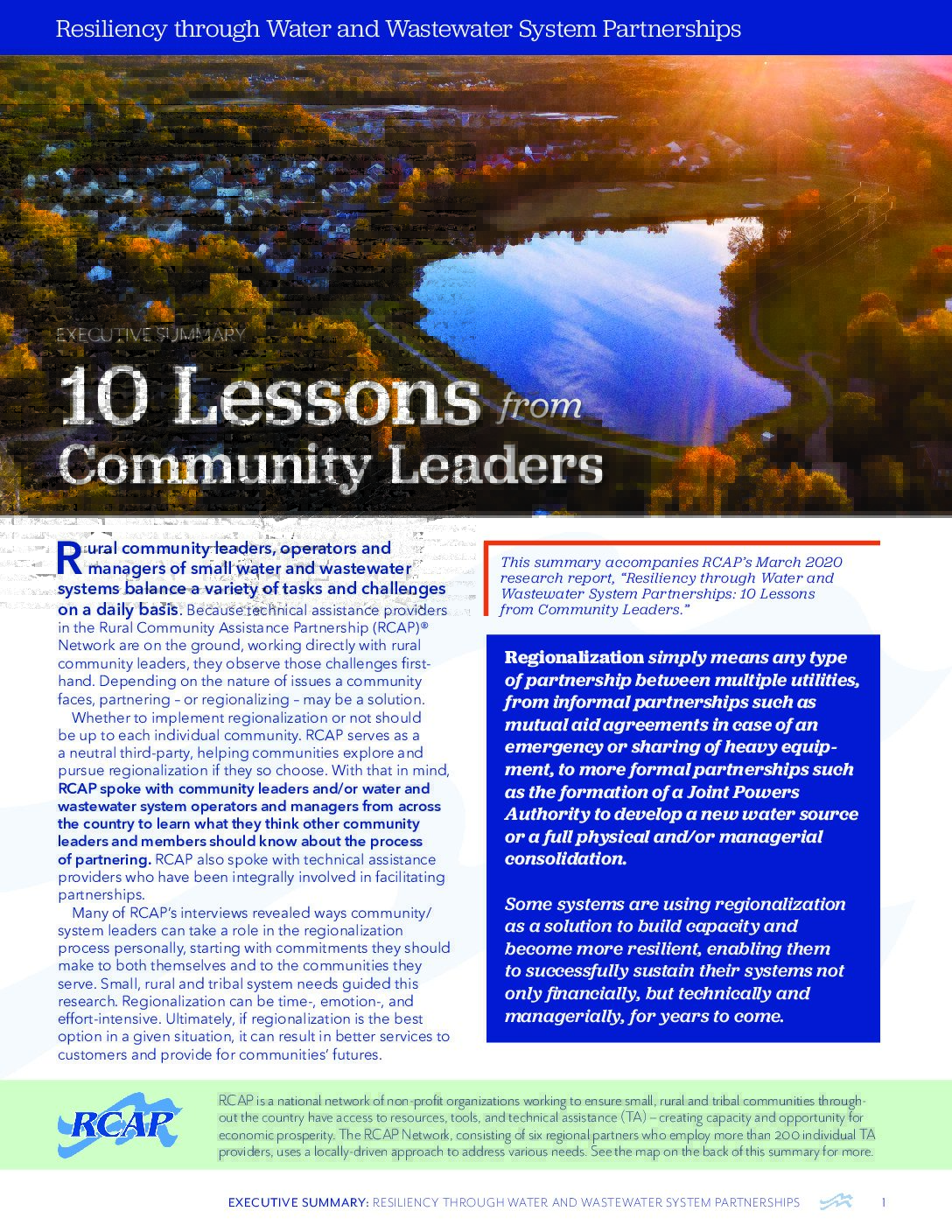
If you would like more information on regionalization, we have a guide that will explain the diverse spectrum of regional collaboration options available, examples of how they have been implemented successfully including best practices, benefits, and barriers, as well as tools and resources to help navigate the process. This guidebook is meant for both community and water/wastewater utility leaders and staff as well as for the technical assistance providers (TAPs) that serve them. Access it here.
Regionalization Research
We’ve noticed the need for a better understanding of regionalization in small, rural, and tribal communities including the broad spectrum of activities that regionalization encompasses, how to go about it, and what to watch out for. With that in mind, we have undertaken a comprehensive research effort since 2019 to understand regionalization experiences at the community level in small, rural, and tribal communities across the nation and analyzed existing and potential policies at each level of government to develop practical findings and policy recommendations. The results of our work are a series of dynamic research reports on regionalization that we hope can be used in practical ways by both community leaders and policymakers at all levels of government.
Regionalization White Paper
RCAP and the National Rural Water Association (NRWA) released an analysis examining how voluntary regional partnerships can help strengthen water and wastewater systems serving small and rural communities. Drawing on decades of on-the-ground technical assistance and system data, the analysis shows how community-led regional collaboration, supported by trusted technical assistance providers, can strengthen long-term sustainability while preserving local governance, community identity and public accountability.
Across the country, rural utilities face increasing pressure from aging infrastructure, workforce shortages, regulatory requirements and rising operational costs. The white paper, titled “Regional Partnership Program: A Community-Led Approach,” underscores that federal policy must support voluntary, community-driven regionalization by ensuring communities have access to planning resources, technical assistance and investment strategies that allow them to evaluate partnership opportunities while protecting local autonomy.
The analysis also identifies several areas where federal support could strengthen these efforts, including leveraging the Farm Bill for targeted assistance, increasing State Revolving Fund resources for regionalization and improving flexibility across federal funding programs.
Key findings of the white paper include the following:
- Rural utilities face significant infrastructure pressures. The U.S. Environmental Protection Agency estimates that roughly $625 billion will be needed for drinking water infrastructure improvements in the coming decades, creating major challenges for small systems with limited financial and technical capacity.
- Regionalization is most effective when it is voluntary and community-led. This approach allows utilities to collaborate, share expertise and strengthen technical, managerial and financial capacity while preserving community identity.
- Regionalization includes multiple partnership models. Communities may pursue shared services, joint purchasing, contractual assistance, regional entities or voluntary consolidation depending on local needs.
- System size alone does not determine regulatory performance. National data shows that larger systems do not consistently outperform smaller systems in regulatory compliance.
The full white paper is available for download here.